Back to Blogs
A practical guide to how license plate cameras help businesses track vehicles, reduce risk, and automate security and operations across multiple industries.

Every day, thousands of vehicles pass through your business. Some are customers. Some are vendors. And some are problems you won't know about until it's too late—a theft, a fraudulent claim, or a security incident with no clear record of what actually happened.
License plate cameras solve this by automatically capturing, reading, and logging every vehicle that enters your property. But unlike basic security cameras that just record footage, license plate recognition cameras turn raw video into searchable, actionable data that integrates with the systems you already use.
This guide explains what license plate cameras actually do, where they're being used right now, and what businesses should look for when choosing an LPR camera system.
Standard security cameras record everything. License plate cameras identify what matters.
A license plate recognition camera captures vehicle plate numbers automatically, even when cars are moving at highway speeds or entering in low light. The system converts each plate into a searchable record—timestamped, tagged, and stored in a database you can query instantly.
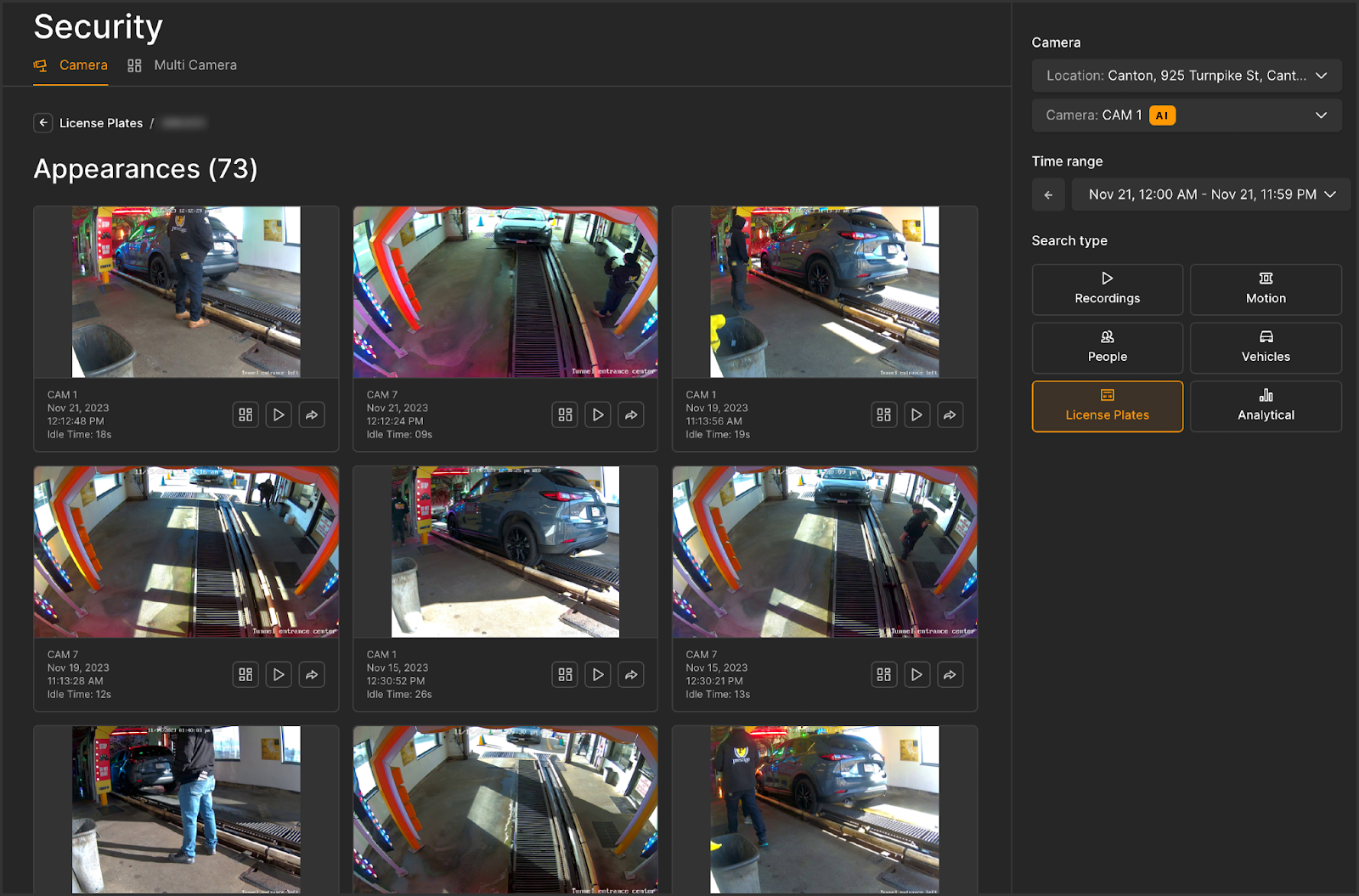
This matters because video footage alone creates a needle-in-haystack problem. If a customer claims damage happened at your car wash three weeks ago, you'd need to scrub through hundreds of hours of footage to find their vehicle. With license plate camera software, you search the plate number and pull up every entry, exit, and related video clip in seconds.
The difference isn't just speed. It's automation. License plate cameras for business eliminate manual logging, reduce disputes, and create an audit trail that works without someone watching monitors all day.
License plate recognition cameras aren't limited to parking enforcement. Businesses across industries are using LPR camera systems to solve specific operational problems.
Car wash operators face constant disputes over scratches, dents, and missing parts. License plate cameras capture the vehicle's condition on entry and exit, creating a before-and-after record that resolves claims instantly. The system also tracks wash times and identifies bottlenecks in the tunnel, helping operators optimize throughput without guesswork.
Learn more: How Car Washes Use LPR to Prevent Fraudulent Damage Claims
Organized retail crime often follows patterns. The same vehicles return to multiple locations, hitting different stores in a coordinated sequence. LPR cameras for parking lots flag known plates in real time, alerting security before suspects enter the building. Some systems integrate with regional databases, allowing retailers to share information and identify cross-location threats.
In large distribution centers, trailers get misplaced. Drivers waste time hunting for loads. License plate cameras automatically log every truck and trailer entering the yard, tracking their location as they move between docks. Dispatchers see real-time inventory of what's onsite, reducing dwell time and preventing missed pickups.
School administrators need to know who's on campus without creating friction for parents and staff. Vehicle tracking cameras maintain an approved list and flag unauthorized vehicles the moment they enter. The system integrates with access gates, automatically opening for recognized plates while alerting staff to unknowns—no RFID tags or manual check-ins required.
Transportation facilities use license plate recognition cameras to monitor restricted zones and track vehicles moving through public areas. When a flagged plate crosses into a secure perimeter, the system triggers alerts and locks down access points. The integration with broader security systems allows operators to correlate vehicle movement with other threat indicators in real time.
Not all license plate recognition cameras are built the same. The difference between a system that works and one that creates more problems than it solves comes down to a few critical features.
Accuracy under your conditions: Test the system with your actual lighting, vehicle speeds, and camera angles. A 99% accuracy rate in ideal conditions might drop to 85% in yours. Ask vendors for proof of performance in similar environments.
Integration with existing systems: The LPR camera system should connect to your video management software, access control, POS, or incident management platform. Standalone systems create data silos. Integrated systems trigger automated actions—locking gates, flagging transactions, sending alerts—without manual intervention.
Searchability and retention: If you can't search your data, you can't use it. Look for systems that let you query by plate, date range, time of day, or custom tags. Retention policies should match your compliance requirements, with automatic archiving and retrieval for legal or insurance purposes.
Real-time alerts: The system should flag plates against watch lists instantly, not hours later during a manual review. Real-time alerts enable proactive security, not just reactive investigation.
Scalability: Your needs will grow. The system should handle additional cameras, locations, and users without requiring a complete rebuild. Cloud-based license plate camera software typically scales more easily than on-premise solutions.
Support and training: A system is only as good as your team's ability to use it. Vendors should provide training, ongoing support, and regular software updates to improve accuracy and add features.
License plate cameras are powerful alone. Integrated with other systems, they become transformative.
Video integration: LPR data becomes the index for your video footage. Instead of scrubbing timelines, you search a plate number and jump directly to relevant clips. This turns passive recording into active investigation.
POS integration: Retailers can correlate vehicle plates with transaction data, identifying fraud patterns like refund abuse or gift card scams. When the same vehicle shows up at multiple locations with suspicious returns, the system flags it automatically.
Access control integration: Gates, barriers, and doors open automatically for approved vehicles while blocking unknowns. This eliminates manual check-ins, reduces staffing costs, and creates a frictionless experience for authorized users.
Incident management integration: When a plate triggers an alert, the system can automatically create a case file, attach relevant video, notify security, and log the response. This eliminates manual data entry and ensures nothing falls through the cracks.
The result is a unified platform where vehicle data connects to every other piece of information your business generates. You're not just tracking cars—you're building a complete picture of who's on your property, what they're doing, and whether it aligns with your business rules.
The right LPR camera system depends on what problems you're trying to solve.
Start with your use case: Are you preventing theft? Resolving disputes? Optimizing logistics? Different applications require different features. A car wash needs fast reads and tight video integration. A warehouse needs yard management and trailer tracking. Define your primary goal before evaluating vendors.
Understand the AI behind the system: Many LPR providers license third-party recognition engines, which means they're limited by another company's accuracy, update cycles, and feature roadmap. Systems built on proprietary AI can adapt faster to your specific challenges—unusual plate formats, difficult lighting conditions, or regional variations—because the vendor controls the entire technology stack.
Check if it works with your existing cameras: Replacing an entire camera infrastructure is expensive and disruptive. The best license plate camera software works with cameras you already have installed, transforming them into license plate recognition cameras through AI processing. This dramatically reduces deployment costs and timeline. If new cameras are needed for optimal coverage, look for vendors who provide placement consulting and installation support, not just software.
Evaluate accuracy in your environment: Request a demo or trial period. Test the system during different times of day, in various weather conditions, and with the types of vehicles you see most often. Compare actual performance to vendor claims.
Assess integration options: If the system can't connect to your existing video, access control, or business software, it's creating a silo. Ask for documentation on APIs, supported integrations, and customization options.
Consider total cost of ownership: Factor in hardware, software licensing, installation, training, and ongoing maintenance. Cloud-based systems often have lower upfront costs but higher recurring fees. On-premise solutions require more infrastructure but offer more control.
Test usability: The system should be intuitive enough that your team actually uses it. Complex interfaces lead to underutilization. Request user training and evaluate whether your staff can search plates, generate reports, and manage alerts without constant IT support.
Check vendor stability and support: You're investing in a system that will run for years. Choose vendors with proven track records, regular updates, and responsive support teams. Ask for customer references and check reviews from businesses similar to yours.
License plate cameras aren't just surveillance tools—they're operational systems that touch multiple parts of your business. The right platform reduces risk, automates manual work, and turns vehicle data into a competitive advantage.
Ready to see how license plate recognition cameras can work for your business? LiveReach AI built its own license plate recognition AI from the ground up—no third-party dependencies, no accuracy compromises. Our platform works with your existing cameras, turning them into license plate recognition cameras without requiring expensive hardware replacements. If you need new cameras or want to optimize placement, we'll help with that too. Schedule a demo to see the platform in action.
Schedule a demo of our platform to see how LiveReach can improve security at your organization.
Request Demo