Back to Blogs
A side-by-side look at SalesPath, Quivio ACE, and LiveReach SalesCoach—manual sales logging versus AI-powered driveway sales intelligence.
.jpg)
Walk into any successful car wash operation, and you'll find managers focused on conversion rates, average ticket size, and membership penetration. These metrics tell the story of business health, and understanding what drives them has become increasingly important for competitive operations.
Tablet-based solutions like Rinsed SalesPath and the newly launched Quivio ACE from Sonny's have introduced the concept of driveway sales measurement to the car wash industry. Rinsed acquired their solution a few years ago and helped educate operators about the value of tracking sales conversations. Now Sonny's is entering the space with Quivio ACE, creating options as both solutions begin rolling out across the industry.
Both vendors offer a similar approach: equip your team with a tablet device, have them manually log the start and stop of each conversation using button presses, and gain visibility into what's happening at the pay station. This manual logging methodology represents one approach to sales measurement—one that has helped many operators begin tracking performance for the first time.
More recently, a different architectural approach has emerged: AI-powered systems that capture data automatically using existing camera infrastructure. Understanding the differences between these approaches can help operators make informed decisions about which methodology best fits their operational needs.
Manual measurement systems ask frontline staff to log sales conversations while managing lines, handling customer questions, and processing payments. This approach offers simplicity—staff use a familiar tablet interface to record interactions as they happen.
However, this methodology does require consistent execution under pressure. When measurement depends on staff remembering to log each interaction during busy periods, some interactions may go unrecorded. Industry experience suggests that even with good training, manual systems typically capture 60–70% of actual interactions, with the remainder missed during high-pressure moments or staff transitions.
Employee turnover adds another consideration. New hires are already learning wash packages, pricing, customer service standards, and POS systems. Adding manual logging to their workflow means building it into your training program and reinforcing it over time. In operations with higher turnover, maintaining consistent logging habits requires ongoing attention.
One of the key differences between measurement approaches involves audio capture. Manual tracking systems focus primarily on logging conversation outcomes—whether an upsell was attempted and whether it succeeded. Some devices can capture employee audio, but capturing clear customer audio in outdoor, high-noise car wash environments presents technical challenges for handheld devices.
This means manual approaches excel at tracking outcomes (conversion rates, pitch frequency) but provide less insight into the content of conversations. Questions like “Why did customers decline offers?” or “What specific objections came up?” or “What language resonated with customers?” require hearing both sides of the conversation clearly.
Manual tracking systems also typically operate as standalone tools. They focus on logging sales interactions but don’t automatically integrate with video feeds, license plate recognition systems, or broader operational data. This makes them straightforward to deploy but means conversation data exists somewhat independently from other operational insights.
Operators implementing manual tracking systems often report similar adoption patterns. Initial rollout tends to go well—teams are excited about the new tool, managers check reports regularly, and staff commit to consistent usage.
Maintaining that adoption over time requires ongoing attention. Devices need charging, weather protection, software updates, and eventual replacement. When devices encounter issues during busy periods, gaps can occur in data collection. Staff changes mean continuously training new team members on logging procedures.
Some operators find that over time, usage consistency can decline without active management. This isn’t unique to any specific vendor—it reflects a broader reality: any system requiring continuous human intervention in high-pressure environments needs sustained focus to maintain adoption. Understanding this helps operators plan for the training, reinforcement, and management attention manual systems require for long-term success.
While manual tracking represents one methodology for sales measurement, a fundamentally different approach has emerged: AI-powered systems that capture data automatically using camera infrastructure operators already have installed.
LiveReach SalesCoach exemplifies this alternative approach. Rather than asking staff to log interactions, it leverages existing Livereach camera platforms—enhanced with edge computing, AI transcription, and integrated data processing—to measure driveway performance automatically. This architectural difference creates distinct advantages in several areas.
“Our partnership with LiveReach has transformed the way we operate our washes and helps us to be better every single day.”— Paras Khara, Owner, Vibe Car Wash
LiveReach SalesCoach uses edge computing technology to process video and audio data directly at the camera level. Every conversation at the pay station or queue is automatically captured without any staff action required. The system identifies interactions, extracts conversations, and creates structured data through intelligent processing rather than manual logging.
This approach provides complete coverage because it doesn't depend on staff remembering to log interactions. Every conversation is captured consistently, regardless of how busy the operation gets or how experienced the staff member is. There are no gaps from forgotten logging, device issues, or training variations.
Here's where architectural differences become significant. LiveReach SalesCoach captures both high-fidelity employee audio AND customer audio consistently. The camera platform's microphones are positioned and engineered specifically for outdoor car wash environments, handling ambient noise, weather conditions, and distance challenges.
This dual-audio capability provides complete conversation records—not just what employees said, but how customers responded. Operators can identify winning scripts by hearing what resonated with customers. They can understand objections by listening to customer concerns in their own words. They can validate or investigate complaints by reviewing exactly what both parties said.
Every conversation is automatically transcribed using advanced AI. This transforms raw audio into searchable, analyzable intelligence. Operators can instantly search their entire conversation database for any word or phrase: "membership," "too expensive," "thinking about it," "maybe next time," or any specific objection or question.
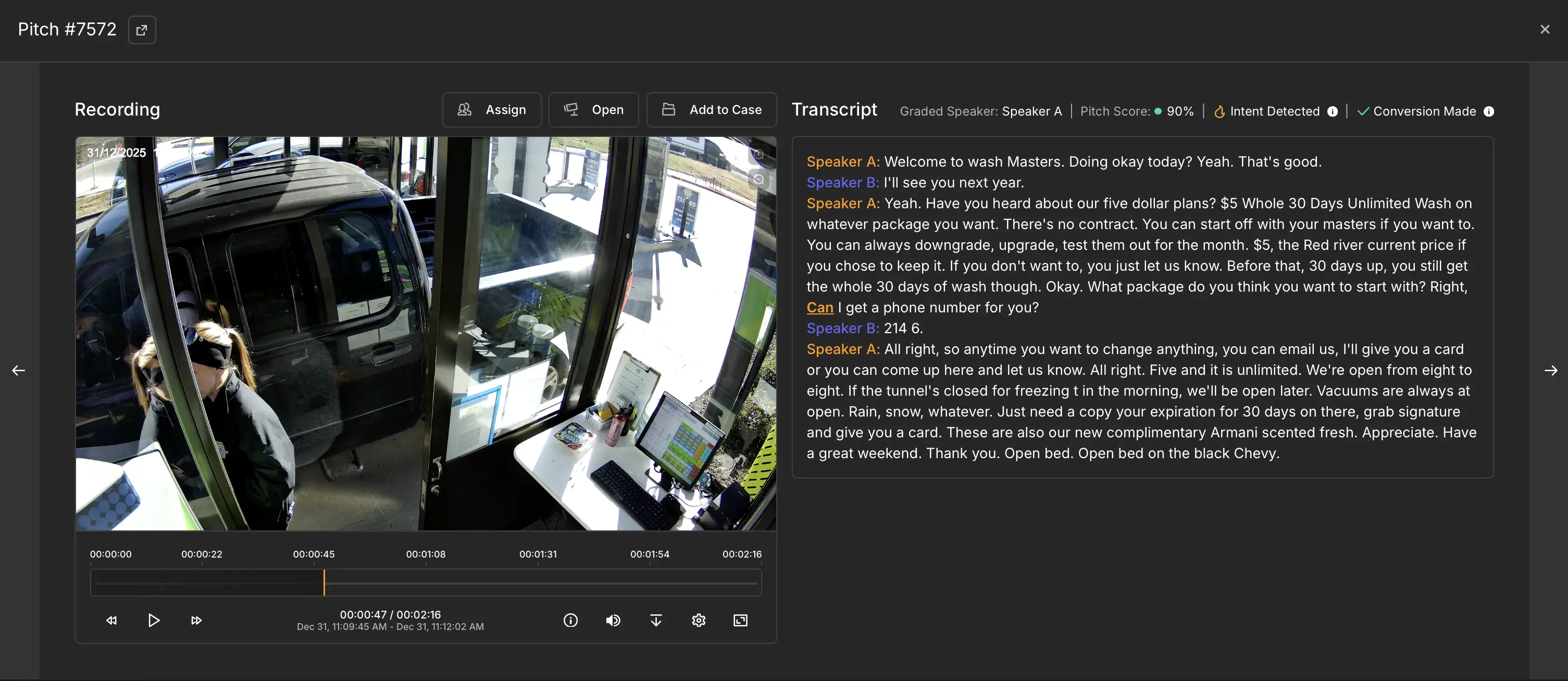
Understanding why membership sales dropped becomes straightforward: search for "not interested" and see every instance, who handled it, and what happened next. Verifying script adoption means searching for key phrases and instantly seeing usage across your team. Competitor intelligence comes from searching for competitor names and understanding what customers say about them.
This creates a strategic asset that grows more valuable over time. Rather than just collecting outcome data, operators build a searchable knowledge base of actual customer language, objections, questions, and responses.
Because LiveReach SalesCoach runs on the camera platform, it automatically provides video intelligence metrics that manual approaches cannot capture. This includes throughput rates, queue lengths, and pay station coverage—all correlated with sales conversations.
The at-bat rate—the percentage of total vehicles that actually receive a sales pitch—becomes measurable. If conversion rates look low, but the at-bat rate shows only 60% of vehicles are being pitched, the real issue becomes clear. Manual systems can't calculate this metric because they only know about logged interactions, not total vehicle throughput.
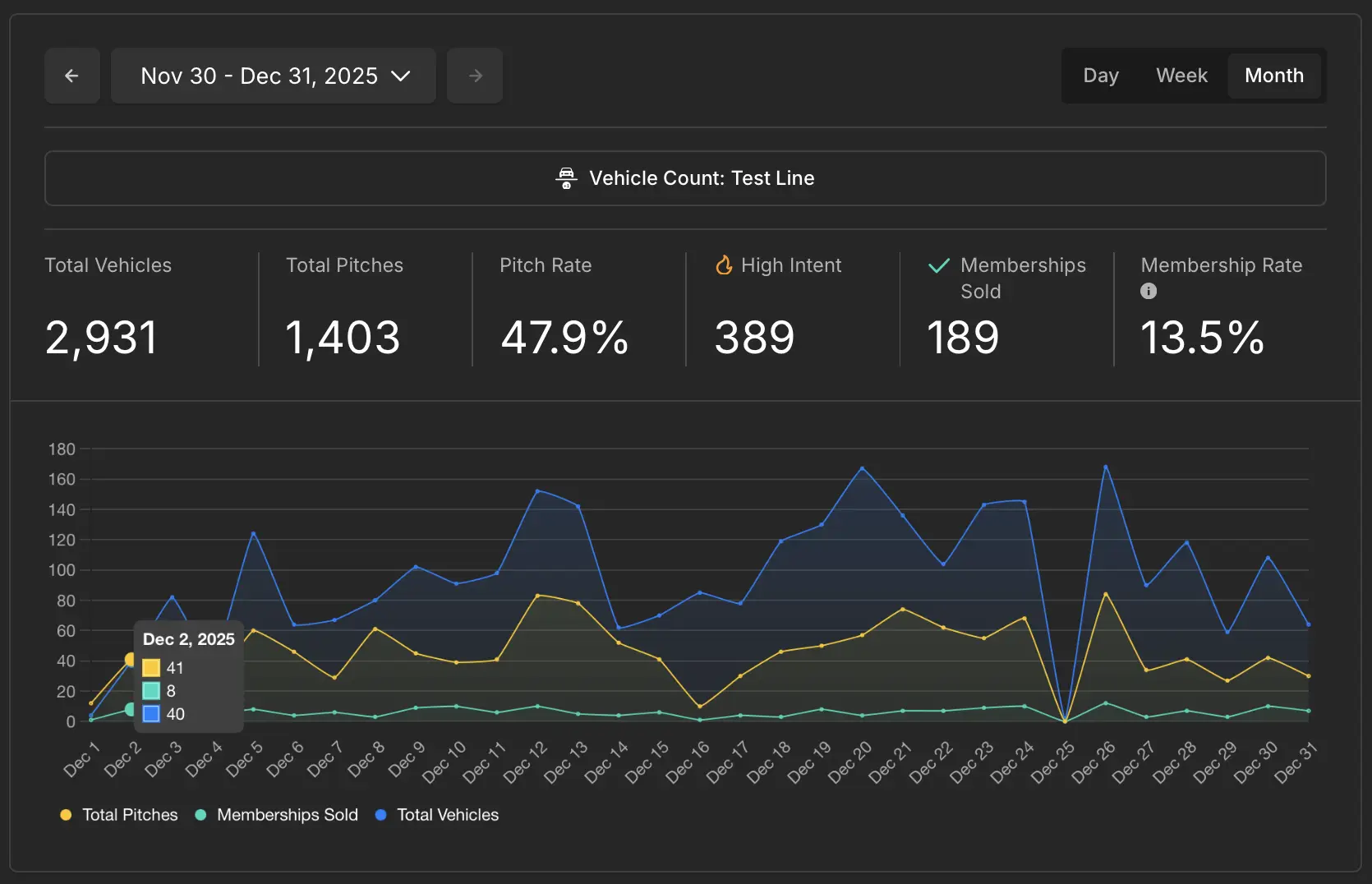
Pay station coverage analysis shows exactly when positions are staffed versus unstaffed, correlated with traffic patterns. Operators can distinguish between conversion problems (staff are pitching but not succeeding) and coverage problems (vehicles are passing through without being pitched). These operational insights emerge naturally when video intelligence and sales data integrate.
Every conversation automatically links to license plate recognition data, customer identity, membership status, and transaction history. This integration enables analysis that isolated systems cannot easily provide: Which specific vehicles are being successfully upsold? How do conversion rates differ between first-time visitors and repeat customers? Do customers with recent service issues respond differently to pitches?
The video-audio-POS integration becomes especially valuable for transaction verification. When a customer disputes a membership charge, operators can pull up the exact transaction, watch the video, listen to both sides of the conversation, and understand definitively what occurred. This protects staff from false accusations while ensuring accountability.
Operators can segment and analyze membership sales by reviewing actual video and audio. What differentiates successful unlimited pitches from unsuccessful ones? Rather than guessing, operators can watch the videos, listen to the conversations, and identify patterns based on direct evidence.
LiveReach SalesCoach's AI identifies high-intent pitches—conversations where customers showed strong interest signals even without purchasing. These "almost conversions" where customers asked detailed questions, expressed curiosity, or said "let me think about it" represent immediate improvement opportunities.
Understanding why sales almost occurred often provides more actionable insight than analyzing successful conversions. Was there an objection the team couldn't answer? Confusion about terms? A moment where the customer seemed ready but wasn't asked for the sale? These abandoned cart moments become visible and addressable.
The system enables customer re-targeting based on demonstrated interest. When someone shows genuine curiosity but doesn't purchase, operators have their license plate, conversation transcript showing what interested them, and context about what held them back. On their next visit, staff can address specific concerns with relevant information.
After initial installation, LiveReach SalesCoach operates autonomously through edge computing. The system captures data automatically, processes it locally at the camera level, and makes insights available without ongoing device management. No device monitoring. No compliance enforcement. No constant retraining on logging procedures.
This operational model means site managers focus on improving performance rather than managing data collection technology. Regional managers analyze data across locations without worrying about adoption consistency. Corporate leadership gets reliable metrics automatically.
Manual tracking systems require hardware investment: tablets, protective cases, mounting solutions, and charging infrastructure for every location. These components need replacement as they age or break, creating an ongoing hardware refresh cycle. Operators are essentially building parallel infrastructure solely for data collection.
LiveReach SalesCoach leverages camera hardware operators already have installed for security and operations. No additional devices to purchase, mount, maintain, or replace. No battery management requirements. No device replacement cycles. This architectural difference typically results in 50% lower total cost of ownership, with the economic advantage growing as operations scale across multiple locations.
Beyond hardware economics, consider operational cost differences. Manual systems require staff time for device management, troubleshooting, training coordination, and compliance monitoring. Edge computing approaches eliminate these operational overhead categories because the technology operates autonomously.
The LiveReach SalesCoach roadmap includes advanced AI capabilities that become possible when comprehensive audio and video data exists. Tonality analysis will assess not just what was said but how—identifying enthusiasm versus hesitation, confidence versus uncertainty, in both customer and employee voices.
Understanding communication patterns represents another frontier enabled by video intelligence. Analyzing how different approaches and techniques correlate with successful outcomes allows for increasingly effective coaching strategies.
These aren't theoretical features—they're natural progressions of a platform already capturing rich audio and video data. Systems built on manual logging architectures face inherent limitations in developing these capabilities because the foundational data (customer audio, video context, integrated operational data) doesn't exist to analyze.
The table below compares Rinsed SalesPath, Quivio ACE, and LiveReach SalesCoach across sales data capture, automation, and operational impact for car wash driveway sales.
Both manual tablet tracking and AI-powered video intelligence represent valid approaches to driveway sales measurement, each with distinct characteristics that appeal to different operational priorities.
• Want a straightforward, familiar tablet interface
• Are comfortable with outcome-focused data (conversion rates, pitch frequency)
• Have strong training programs and can maintain logging discipline
• Prefer standalone tools that focus specifically on sales logging
• Are willing to invest management attention in sustaining adoption
• Need complete data capture without depending on staff compliance
• Want to understand conversation content, not just outcomes
• Value integrated operational insights (at-bat rates, coverage, throughput)
• Prefer autonomous systems that don't require ongoing device management
• Seek to leverage existing camera infrastructure investments
The question isn't which solution is "better" in absolute terms—it's which architectural approach aligns with your operational priorities, management style, and strategic objectives. Understanding these differences helps operators make choices that support their specific business goals.
For operations focused on maximizing insight from every customer interaction while minimizing operational overhead, AI-powered video and audio intelligence represents a compelling path forward. The edge computing and integrated intelligence approach provides capabilities that simply aren't possible with manual logging architectures—not because of vendor execution, but because of fundamental architectural differences.
The car wash industry is seeing multiple approaches to sales measurement emerge simultaneously. Understanding what each approach offers—and what it inherently cannot offer due to architectural constraints—empowers operators to make informed decisions that serve their unique needs.
A: Rinsed SalesPath is a tablet-based driveway sales tracking solution that Rinsed acquired a few years ago. It allows car wash staff to manually log sales conversations by pressing start and stop buttons on a tablet device at the pay station. The system tracks conversation outcomes, pitch frequency, and conversion rates, helping operators understand their driveway sales performance. SalesPath includes features like rewards programs, team collaboration tools, and sales gamification to motivate staff and encourage consistent usage.
A: Sonny's Quivio ACE is a newly launched solution that takes a similar architectural approach to Rinsed SalesPath. Both are tablet-based manual tracking systems that require staff to log interactions via button presses. The primary difference is the vendor—Rinsed is an established CRM player that built on top of Sonny's POS system, while Quivio ACE is Sonny's own solution competing in the same space. Sonny's Quivio Ace has a native integration with the Sonny's Back office point of sale, allowing sales reps to fully complete the membership sale on the tablet. From a functionality standpoint, both solutions offer comparable manual logging workflows with similar strengths and limitations around data completeness, audio capture, and operational requirements.
A: Manual tablet-based systems like Rinsed SalesPath and Quivio ACE require upfront hardware investments (tablets, protective cases, mounting equipment, charging stations) at each location, plus ongoing subscription fees. Replacement devices and maintenance add to long-term costs. LiveReach SalesCoach typically costs 50% less in total cost of ownership because it leverages camera infrastructure operators already have installed for security purposes—eliminating the need for additional hardware, device management, and replacement cycles. The exact pricing varies by operation size, but the architectural difference (additional hardware vs. existing infrastructure) creates a significant economic gap that widens as operations scale across multiple locations.
A: The answer depends on your operational priorities and resources. Small operations with strong training programs and low staff turnover may find manual tablet tracking (Rinsed SalesPath or Quivio ACE) sufficient for basic conversion rate tracking. However, small operators often have the least bandwidth for device management and compliance monitoring. AI-powered video intelligence like LiveReach SalesCoach can be particularly valuable for smaller operations because it provides complete data capture without requiring ongoing staff training or device management—essentially giving you enterprise-level sales intelligence without enterprise-level operational overhead. Consider whether you have the management capacity to sustain manual logging adoption or would benefit from an autonomous system that works regardless of staffing changes.
A: Yes, all three solutions offer POS integration, but the scope and purpose differ significantly. Rinsed SalesPath and Sonny's Quivio ACE integrate with all major car wash POS systems to log sales outcomes and track conversion metrics. LiveReach SalesCoach currently integrates with NXT and Sonny's POS systems, though POS integration represents only a small component of the overall solution.
Schedule a demo of our platform to see how LiveReach can improve security at your organization.
Request Demo